None of the fun of cellular biology or genetics would be possible without the discoveries of Anton van Leeuwenhoek. Van Leeuwenhoek, a Dutchman who lived in 17th-century Delft, was the first human to see microscopic bacteria and protozoa. He didn’t speak Latin or Greek (like most scholars of his day), he didn’t have formal higher education, and he wasn’t affiliated with any university. He started a drapery business and originally starting fooling around with grinding lenses in order to see the quality of his fabrics in finer detail than existing magnifying glasses allowed.
His lens making eventually led him to look at an ox tongue in 1674 with his homemade and very odd-looking microscope. He saw the ox’s taste buds—this was inspired by seeing gunk on his tongue in a mirror when he was suffering from a sore throat, and he wanted to see what else was on tongues.
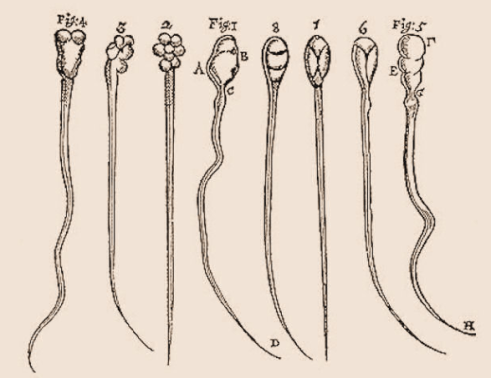
A couple of years later, he looked at cloudy water and saw “wee animalcules” wiggling around. He was delighted, and looked at all kinds of samples of “cavorting beasties.” Cloudy water led to animal sperm (like the picture above), the scum on teeth, and lots of other heretofore-unexplored flora and fauna. Below is a replica of one of his microscopes, which looks a bit like hardware for a steam-punk front door. Next to it is a drawing of van Leeuwenhoek in his curly and, I assume, itchy wig, and awesomely puffy garments, peering through the eyepiece of his tiny microscope. Did he really wear his wig alone at night?


Van Leeuwenhoek was not actually the first person to see a microorganism. That was probably the Englishman Robert Hooke, who looked at microfungus and ant eyes at about 20x magnification. In 1665, Hooke published his findings in the book Micrographia, and it caused a sensation when it hit the press.
Van Leeuwenhoek created microscopes that were able to focus at a remarkable 275x magnification. And even earlier in the 17th century, Galileo Galilei was experimenting with microscopy. He is famous for his 1609 observation that the moons of Jupiter orbited Jupiter, not the Earth. He used a Dutch telescope for that discovery, but he also made his own microscope in about 1619. Galileo may have seen something that could have been world-changing with his microscope, but he was totally uninterested in pursuing it. Evidently, the miniature world did not hold the same charms for him as the heavens. It’s a case of not finding what you are not looking for. Galileo was intrigued and consumed by the study of astronomy; van Leeuwenhoek was fascinated by something no one else was looking at, chiefly because he just wanted to know.
His famous quote:
My work, which I’ve done for a long time, was not pursued in order to gain the praise I now enjoy, but chiefly from a craving after knowledge, which I notice resides in me more than in most other men. And therewithal, whenever I found out anything remarkable, I have thought it my duty to put down my discovery on paper, so that all ingenious people might be informed thereof.
As one of my instructors said, it isn’t science until you write it down, and it seems van Leeuwenhoek agreed. Even though his observations were widely circulated during his lifetime and caused a flurry of interest, the study of microbes languished for the next 200 years. Van Leeuwenhoek did not share the details of his amazing lens grinding and it was only in the last century that others have been able to recreate his lenses. When he died in 1723, he left 26 of his microscopes to the Royal Society in London. Sadly, they have all disappeared, probably filched by sticky-fingered Royal Society members and currently residing in dusty attics across England.
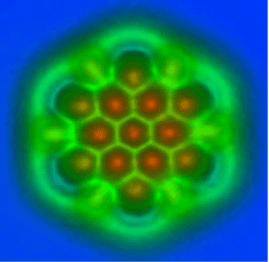
Today we have atomic-force microscopy with a resolution of fractions of a nanometer (a.k.a. one billionth of a meter). With this microscope, you can actually see the chemical bonds in individual molecules. It allows us to see how proteins fold, which should lead to amazing advances in treating diseases and increase our understanding of how the biological world works at an atomic level. Wouldn’t van Leeuwenhoek have loved to see this? Here is a nanographene molecule showing carbon-carbon bonds and it’s just gorgeous.
While researching van Leeuwenhoek, I found out that he was the executor of Johannes Vermeer’s will after the painter’s death in 1675. They must have at least been acquaintances, right? Did they dine and drink beer together? Talk about art and microorganisms? Did Vermeer look through one of van Leeuwenhoek’s microscopes at a particle of one of his own paintings? I would dearly love to know.
 Successive Approximation
Interesting in so many levels! Bravo!
LikeLike
My Grandfather, Louis Harold, made this drawing of van Leeuwenhoek as a young man supporting his children as an illustrator. Like so many artists, he is never credited….really nice to see it here and in wide use.
LikeLike