Xander Blakely and I were office mates at Seattle’s Russian-American Foundation in the late 1990s. Those were good times, filled with lots of laughter and discussions of cross-cultural misunderstandings. Xander is a large man of Scandinavian descent, and I am not, but we both shared hearty appetites. I remember eating pasta for lunch one day and saying that I couldn’t shovel it in fast enough, and he understood. His linguistic abilities are amazing; actual Russians thought he was Russian born and bred. He wrote a highly entertaining book about four years he spent doing a start-up in Siberia called Siberia Bound: Chasing the American Dream on Russia’s Wild Frontier. He wanted to call it Running from Comfort, which I like a lot better, but his publisher nixed that.
While in Siberia, he fell in love with Natasha, a beautiful young student of mathematics. Before they married, he took her on her first trip outside of Russia to Venice, Italy. She was so overwhelmed by the beauty and elegance of the architecture and all things Italian in general, that she had to sit down, head in hands, saying “I just can’t take it.” That’s exactly how I feel about stem cells.
Below is a picture of Natasha (in red) and me that I love because it has a secret. The blastocyst that would eventually become the cantankerous and recalcitrant infant Patrick, is, I believe, just about to implant and begin the work of embryonic stem cells–dividing and differentiating into organs, blood, and neurons.


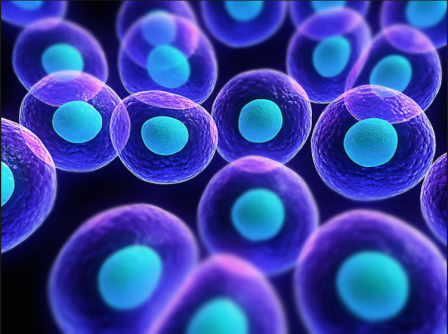
A blastocyst is the clump of cells that you end up with about 4 or 5 days after an egg is fertilized by a sperm. These cells are known as pluripotent stems cells or embryonic stem cells, and they are mighty powerhouses of production and repair. Their pluripotency derives from their ability to self-renew, which means they can endlessly create copies of themselves, or differentiate and make cells that will form our three basic body layers. A stem cell can be the progenitor cell for the ectoderm (your basic outside layer-skin and nerve tissue), endoderm (inside layer-gastrointestinal and respiratory stuff, liver, pancreas, endocrine glands), and mesoderm (middle layer-bone, blood, muscles, connective tissue).
Stem cells have already been used to treat diseases of the immune system, blood diseases, and for skin grafts. The possibilities for them to provide new treatments for diseases is positively mouth-watering. But in 2001, a big wrench was thrown into stem cell research when GW Bush banned federal funding for stem cells developed from preimplantation human embryos.
Using “leftover” embryos produced in fertility clinics made a lot of people squeamish. I’m not one of them. I understand that a fertilized egg is not the same thing as a sperm or an oocyte, but those sperm and oocytes also have the potential to become human life. I think, why not follow that logic all the way upstream to Monty Python’s Every Sperm is Sacred from The Meaning of Life. The clip, by the way, has some fun dance choreography.
Dr. Shinya Yamanaka of Japan found a way around the controversy in 2006 when he figured out to how reprogram adult cells to go back to the pluripotent stage, then forward to a differentiated cell. Imagine taking a skin cell and fiddling with it to produce a pancreatic cell. Dr. Yamanaka’s technique is called induced pluripotent stem cells, or iPS cells. iPS cells are made from the cell nucleus of an adult somatic cell. Somatic cells are body cells, as opposed to a germ cell like an egg or a sperm. No fertilized egg cells are required.
For this brilliant work, he won the 2012 Nobel Prize in Physiology or Medicine. This video about his discoveries is long, almost 17 minutes, but well worth the time if you are interested in the subject. It has some really refined animations illustrating how stem cells work. I found it fascinating, though I did think that Dr. Yamanaka looked a little too young to get a Nobel Prize.
The promise is that patient-specific iPS cells will let us take our own pluripotent stem cells and create new tissues (or even organs!) for transplantation. We could make insulin producing cells, heart cells, corneal cells – whatever we need, without the risk of transplant rejection. It sounds like science fiction, and it may be decades away, but that’s a world I want to live in.
 Successive Approximation